Traces
Suspicious! But Plausible?
Here I share intriguing discoveries, fascinating research findings, and behind-the-scenes glimpses into the creation of my stories. In short: anything that catches my attention and refuses to let go.
Benfordsches Gesetz - Wenn Zahlen Geschichten erzählen.
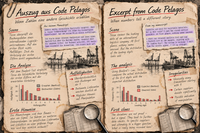
Excerpt from Code Pelagos
Tessa has a feeling that something isn't right. She decides to investigate. Using Benford's Law to analyse the data, she has no idea what she's getting herself into.
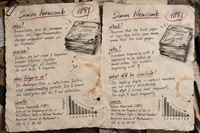
1881 The Discovery by Simon Newcomb
In 1881, mathematician Simon Newcomb described how logarithmic tables showed uneven signs of wear and observed that leading digits occurred with unequal frequencies.
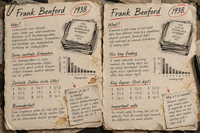
1938 Further Research by Benford
Frank Benford analysed approximately 20,000 numbers from various fields and confirmed the unequal distribution of leading digits that Newcomb had first described in 1881.
2022 The Application in Financial Auditing
Mark Nigrini demonstrates how Benford's Law can help identify unusual accounting entries. But not every irregularity indicates fraud. Sometimes, there's a perfectly plausible explanation.
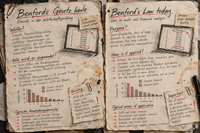
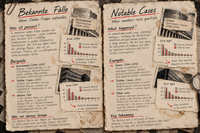
I've taken the liberty of creating all illustrations with the assistance of artificial intelligence. They are intended solely for illustrative purposes. They are fictional and do not represent authentic historical documents or actual research findings. I do hope, however, that they capture the key insights reasonably well.
For those who would like to explore the subject in greater depth or approach it from a scientific perspective, the original publications and studies can be found through the linked sources.
Code Pelagos is a work of fiction. All characters, companies, and events are fictional. Real locations, scientific findings, and economic circumstances may serve as inspiration for the story. Any resemblance to actual persons, companies, or events is entirely unintentional.